What Eating Disorder Awareness Week Is Really About
It’s More Than a Post
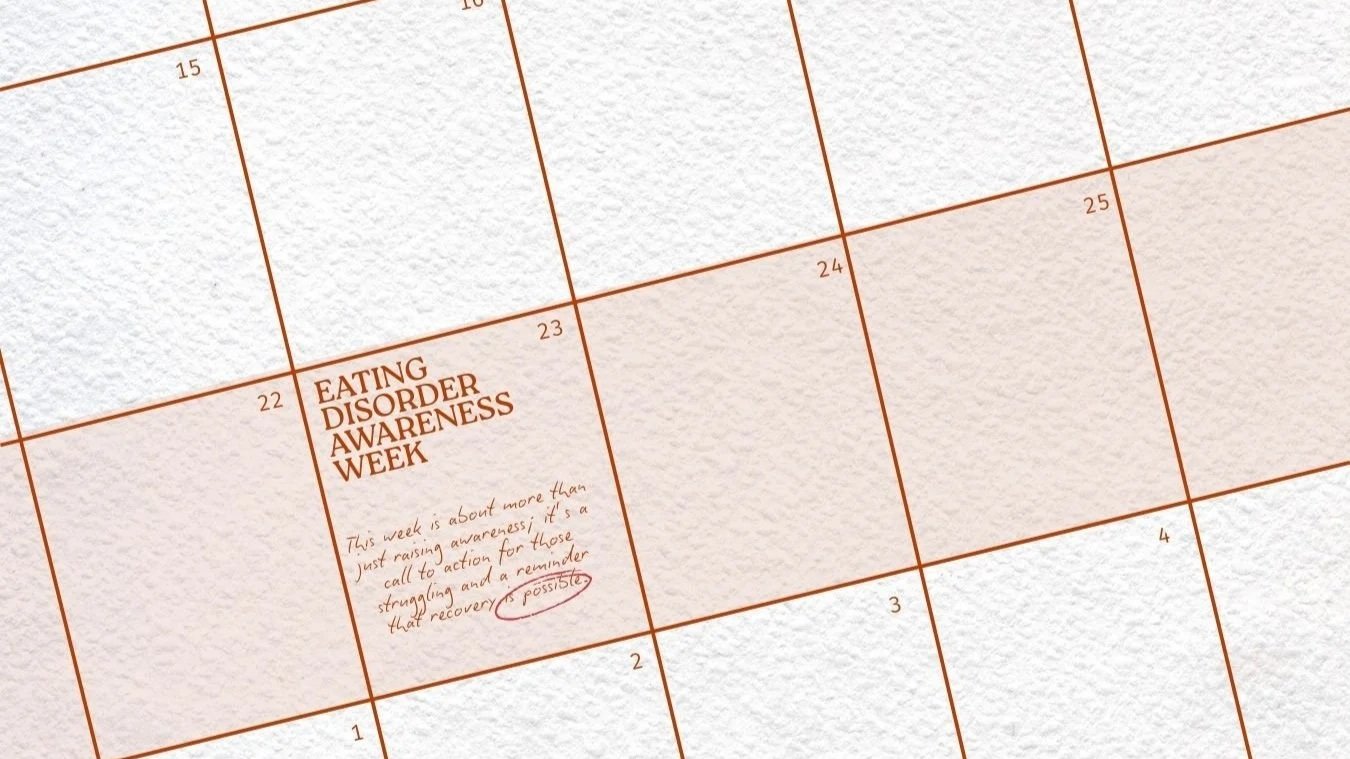
It’s Eating Disorder Awareness Week.
You’ll likely see statistics shared, infographics reposted, and lists of warning signs circulating online. Those things matter. Education matters. Visibility matters. But awareness is more than sharing numbers for seven days. It’s more than a themed week, more than a graphic, more than a hashtag.
Eating Disorder Awareness Week invites us to slow down and look more closely at the narratives we normalize, the behaviors we dismiss, and the assumptions we still carry about who struggles and what that struggle should “look like.” Awareness isn’t about creating panic. It’s about increasing understanding. And we still need that.
What It’s Not
Eating Disorder Awareness Week is not just about extreme cases and shock value. It’s not only about someone who is visibly underweight, and it’s not limited to teenage girls. It’s not just about food, and it’s not about labeling every wellness habit as disordered or shaming people for caring about their health.
But it is about recognizing when “discipline” becomes rigidity. When “healthy” becomes fear-based. When “mindful” becomes obsessive. When someone’s world quietly gets smaller.
It’s also important to remember that many people struggle long before meeting full diagnostic criteria, and many never receive a formal diagnosis at all. Awareness expands our lens. It asks us to look beyond stereotypes and beyond extremes, because eating disorders rarely announce themselves loudly in the beginning. They often start quietly.
What It Is
Eating Disorder Awareness Week is about making the invisible more visible. It’s about noticing shifts. Shifts in mood, in flexibility, in social patterns, in anxiety around food or body image. It’s about understanding that eating disorders are not solely rooted in vanity. They are complex mental health conditions that often function as coping mechanisms. Eating disorders function as ways to manage anxiety, numb emotion, create control, or create a sense of safety when things feel overwhelming.
Awareness is also about early intervention. The sooner someone receives support, the stronger the long-term outcomes tend to be. And yet so many individuals delay reaching out because they don’t believe they are “sick enough”. Awareness challenges that belief, and it reduces the quiet shame that eating disorders thrive one. It creates space for someone to say, “Something feels off,” without needing to prove their pain.
It helps parents recognize subtle warning signs before patterns escalate. It helps friends respond with curiosity instead of cristicism. It helps providers ask deeper questions. Most importantly, it reduces secrecy. Eating disorders thrive in isolation. Awareness interrupts that silence.
The Cultural Layer We Can’t Ignore
We also can’t talk about awareness without acknowledging the environment we live in. Ours is a culture that automatically praises weight loss, moralizes food, normalizes body dissatisfaction, and markets restriction as self-improvement.
In that context, disordered behaviors can hide in plain sight. Someone can be complimented on weight changes that are rooted in distress. Someone can be considered disciplined when they are actually exhausted. Awareness asks us to pause before reinforcing these narratives. It invites us to reconsider casual body comments, rethink how we talk about food and worth, and challenge the assumption that smaller automatically means healthier or happier.
Awareness is cultural, not just clinical.
An Invitation to Join The Conversation
Eating Disorder Awareness Week is not meant to overwhelm you or produce fear. It’s an invitation to learn something new, reflect on language, check in with someone gently, or check in with yourself honestly.
It’s a reminder that eating disorders affect people of all genders, ages, body sizes, ethnicities, and backgrounds. It’s also a reminder that recovery is possible, and that struggling in silence is not a requirement.
If this week feels triggering or activating, that makes sense. Awareness can bring things closer to the surface. That doesn’t mean you’re doing it wrong. It means something matters. And if this week simply increases your understanding, that matters too.
Awareness is not about having all the answers. It’s about paying attention.
And sometimes, paying attention is the first step toward change.
